
How Much Water Should You Drink a Day?
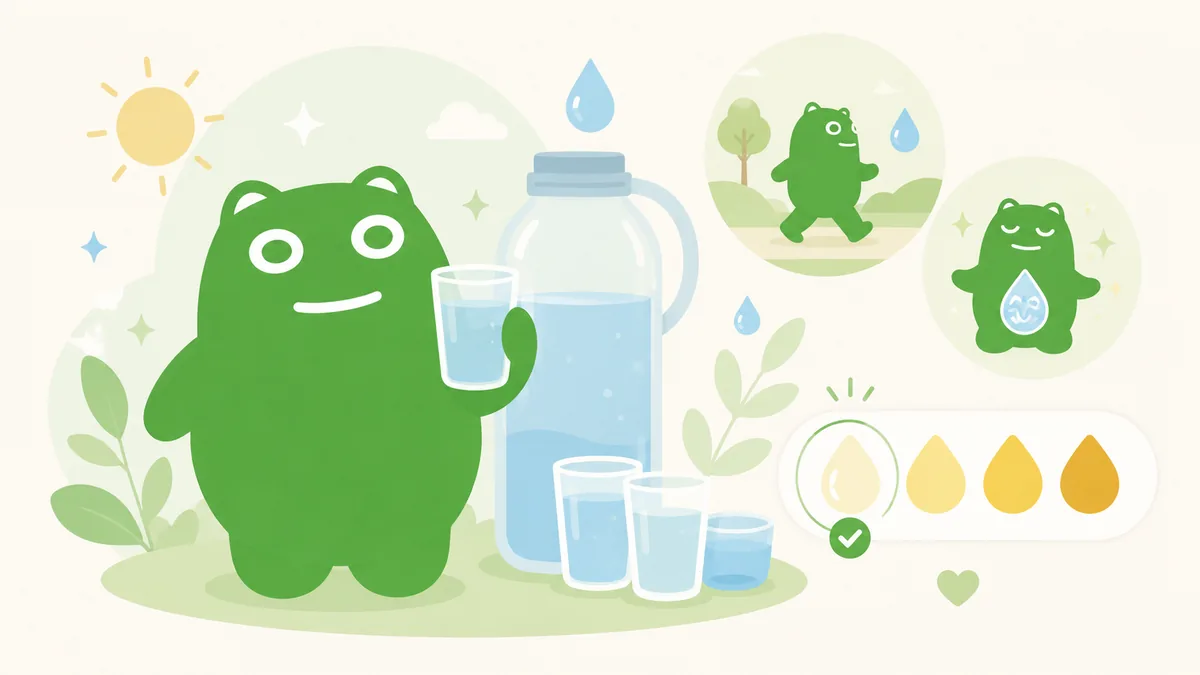
Few health questions get repeated as often as how much water to drink. The honest answer is that it depends on you. This guide covers the general targets from health authorities, the things that move your personal needs up or down, and a simple way to check whether you are actually drinking enough.
The quick answer
There is no magic number that works for everyone. As a broad guide, the U.S. National Academies suggest roughly 2.7 liters of total fluids a day for women and about 3.7 liters for men. That total counts everything: plain water, other drinks like tea, coffee, and milk, and the water you get from food. Because food and other drinks already cover a good share, the amount you need to drink as plain water is lower than those totals.
The well-known eight glasses a day, around 2 liters, is a reasonable rough rule, but it is not a strict requirement and it does not suit every body or every day. Treat the figures above as a starting point, then let your own signals fine-tune the amount.
What affects how much you need
Your daily need is not fixed. Several everyday factors push it up or down:
Activity and sweat: the more you move and sweat, the more fluid you lose and need to replace. A hard workout or a long walk can add a noticeable amount.
Hot or humid climate: heat and humidity raise sweat losses, so you need more on warm days even if you are not exercising.
Body size: larger bodies generally need more fluid than smaller ones, which is part of why men’s suggested totals run higher than women’s.
Pregnancy or breastfeeding: both increase fluid needs, so people who are pregnant or nursing should plan to drink more.
Illness: fever, vomiting, and diarrhea all increase fluid loss, and you may need extra to keep up.
Signs you are not drinking enough
Your body gives clear hints when fluids run low. The common early signs of mild dehydration include:
Dark yellow urine, which is often the first and easiest thing to notice.
Thirst, your body’s built-in prompt to drink.
Fatigue or low energy.
Headache.
A dry mouth or lips.
If you notice several of these together, it is a good moment to have a glass of water and check your urine color.
Can you drink too much
Yes, although it is uncommon. Drinking far more water than your body needs can dilute the sodium in your blood, a condition called hyponatremia, which in serious cases can be harmful. This mostly affects endurance athletes or people who force very large volumes in a short time. For nearly everyone, the takeaway is simple: there is no need to push fluids far beyond your thirst. Drinking to thirst and keeping your urine pale is plenty.
The simplest gauge
You do not need to count every milliliter. Two free signals cover most situations: urine color and thirst. Aim for pale straw colored urine, roughly the shade of light lemonade. If it is consistently darker, drink more. If it is constantly colorless and you are going very often, you may be overdoing it. Pair that with thirst, and you have a reliable, low-effort way to stay in a healthy range without obsessing over a target number.
How bellySignal helps
It is hard to know whether drinking more actually changes anything when you are relying on memory. bellySignal lets you log your water intake, in cups or milliliters, toward a daily goal, and track your urine color right alongside it. Over a few days you can see whether hitting your water goal really shifts your hydration signals toward that pale straw target, so you can dial in the amount that works for your own body rather than chasing a generic number.
Your diary is stored on your device, and no account is required. Selected health values, including stool type, symptoms and manually entered weight, are also sent to PostHog and Firebase Analytics. Both services are enabled by default. The analytics switch controls PostHog only; Firebase Analytics remains active. Privacy policy.
Frequently asked questions
- Is 8 glasses a day enough?
- Eight glasses, roughly 2 liters, is a handy reminder but not a precise target. Many people need more, especially in heat or with exercise, while some need less. Use it as a baseline, then adjust to your thirst and urine color rather than treating it as a fixed rule.
- How do I know if I am dehydrated?
- Common early signs include dark yellow urine, thirst, a dry mouth, tiredness, and headache. The clearest everyday signal is urine color: if it is darker than pale straw, that usually means it is time to drink more.
- Can you drink too much water?
- Yes, though it is rare. Drinking far more than your body needs can dilute blood sodium, a condition called hyponatremia, which can be dangerous. The safe approach is to drink to thirst and keep your urine pale, not to force large amounts well beyond what you feel you need.
Sources
bellySignal provides general wellness information and does not replace professional medical advice or diagnosis.